Showing posts with label selfpub. Show all posts

17 February 2017

Self-pub Statistics 2017

Here's the latest round of statistics, for those who are interested in such things.  I'm being lazy and just using a tool called Book Report to automatically turn all my Amazon sales into nice graphs.  Amazon is still about 85% of my sales, so this gives you a good idea of how it all breaks down for a laid-back non-promo type like me.  [I'd far rather just write and publish than go through promo hoops, which does mean my sales slide between releases.]

[If you want to see just how successful hard work and a solid promo plan (along with good books) can be, check out some of the posts Patty Jansen does on her far more active writing career.]

Earnings per month

First, here's earnings from when I first put my books up on Amazon (a few months after I'd first published them on Smashwords).  The two big peaks are two Bookbub promotions, back when it was easier to get into Bookbub.  The initial early leaps were in the days when putting a book free would have a tangible impact on your sales.  [The third biggest peak, incidentally, is the release of In Arcadia.]


Earnings by book and store

The Touchstone Trilogy is by leaps and bounds my bestseller, as can be seen by the pie chart.  No prizes for guessing which books are represented by the right of the chart.


Numbers and dollars by book

Dividing this by seven years makes the amounts seem much less impressive - but still definitely nothing to sniff at!  Not anything I could gamble on early retirement with, but a solid supplement to my income.  [Publishing and Amazon algorithms are such variable things that I don't think I would ever bank on book royalties until I no longer had things like mortgages to worry about.]


For the future...well, I'd still rather just write and publish and see what happens - the beauty of self-publishing is that the books are mine, and they're not going away, and I'm comfortable with letting my mailing list grow slowly and organically.

Not that I'd object to wild success.  I recently had a rather heart-stopping query from a very major production company about the film/TV rights for Touchstone.  It came to nothing, sadly, but it sure did give me some fun daydreams.  I re-read the trilogy afterwards, and really don't see how it could be adapted without cutting down on the massive cast list - but I thought it would be fun to have a show that paralleled Zan and Cass.  They both technically 'graduate' around the same time and are such different people.

03 December 2015

5 Years!

On 1 December 2010 I published Champion of the Rose and The Silence of Medair (on the same day, to make the question of 'my first book' a matter of some quibbling).  While it would have been a nice bit of symmetry to publish The Sleeping Life this month, it looks like it's going to be a late January-at-earliest publication.

However!  I can still celebrate five years of being published, and as always enjoying writing and having people read my books, and even saying nice things. :)  I doubt I'll hit full-time author status any time this decade, but I'll definitely continue to put out one to two books per year just because I really like doing it. [And commissioning art for them. ;) ]

A giveaway is definitely in order - my entire back catalogue, plus my upcoming The Sleeping Life in whichever format you prefer (TPB or ebook), when TSL finally releases.  [If you have all my books, you can name a character instead!]

This time I'll combine it with a fun survey (well, fun for me).

https://www.surveymonkey.com/r/NFMS5YB

You can fill in the survey without entering to win (or enter without filling in the rest of the survey), and the competition will remain open until the day before release (whenever, sigh, that happens to be) is closed now.

Thanks so much everyone for reading me!  Whenever I'm feeling down about my writing or suffering from self-publisher's chip, all I have to do is read the wonderful reviews, comments and fan mail I've received these past five years and bask. :D

10 July 2015

Five-year financial report

I've been doing my taxes!  What fun!  Since it's my fifth tax return that features an entry (somewhat erroneously) called "royalties", I figure this is a good time to share some stats.

In December 2010, I published Champion of the Rose and The Silence of Medair on Smashwords.  I didn't tell anyone I knew, or do anything particularly resembling meaningful advertising.  Stained Glass Monsters followed in January 2011, Stray in March 2011 and Lab Rat One in June 2011.  My gross earnings up to 30 June 2011 were $76.24 AUD:


It's important to note that Smashwords pays quarterly and Amazon after 3 months, so the above doesn't reflect royalties earned in this period, but royalties paid.  [Smashwords also covers Barnes & Noble, Apple, and a myriad smaller vendors.]

In the 2011-2012 financial year I published Voice of the Lost, Caszandra, and Gratuitous Epilogue.  My gross earnings between 1 July 2011 to 30 June 2012 were $10,160.67 AUD:


In the 2012-2013 financial year I published And All the Stars and Hunting. My gross earnings between 1 July 2012 and 30 June 2013 were $16,645.97 AUD:


In the 2013-2014 financial year I published Bones of the Fair.   I also put a stop on my payments from Amazon for a while so that I would have more money for my overseas holiday (putting off my tax payments).  My gross earnings between 1 July 2013 and 30 June 2014 were $9,300.89 AUD:


You can see that the non-Amazon percentage is creeping up (though a little distorted by my deferring some of the Amazon payment).  This in turn distorts the next year of earnings.

In the 2014-2015 financial year I published The Pyramids of London  My gross earnings between 1 July 2014 and 30 June 2015 were $57,204.78 AUD:


My tax bill this year is going to be hefty.

As you can see the number of vendors has increased (Popcorn Press is the fee for the Touchstone RPG Source Book), but the bulk is still by far coming from Amazon (and by far coming from the Touchstone Trilogy, for that matter, with two rather successful Bookbub promos further distorting this year's royalties).  A further point of distortion is the plunging Australian dollar, which means I get more AUD for any USD these days (and very nice that is from my POV too).

Overall, my earnings look like this:


And, really, woohoo!  That's a lot of money!  A pity it's going to drop by about $20,000 in the current financial year (gauging from current sales/publication rates), but this is still a good deal better than I expected from my five-year check-in on the state of my self-publishing career.

If I were all about the money I'd just spend my time publishing Touchstone sequels, but as ever I'm writing what has my attention at the moment, dividing my time between the quiet and very unlikely to be very profitable The Sleeping Life and the tremendously entertaining and likely to get me my first hate mail Snug Ship.  (Gaming is such a touchy area.)  There are some mild similarities between Snug Ship and Stray (first person voice for a start, though Taia is more mildly snarky rather than self-deprecating and consistently humorous), but it doesn't have a strong romantic plotline, so it will be interesting to see how it's received.

Anyway, this is a post for the stat-collectors.  Sooner or later I will have to get around to the more formidible task of doing charts for the sales numbers.

17 June 2015

Occasionally self-publishing isn't fun

As I mentioned in my previous post, while I really love self-publishing, there are some negatives that anyone considering the route should be prepared for.  Obviously not selling or bad reviews sting, but that's a common experience for many authors.  Not having as many promotional opportunities (and some people simply refusing to read self-pub work) isn't fun either, but I'm pretty good at shrugging that off.

My most negative experience as a self-publisher was an innocuous twitter conversation.

This followed a guest post I'd contributed to the Book Smugglers' web site, where I'd listed 99 female authors.  The post was a response to the usual nonsense about how women don't write SFF.  Instead of producing a list of the same half dozen luminaries whose names seem to turn up on every list (perhaps contributing to the perception that there are few female SFF authors), I simply listed authors I had on my physical book shelves.

An Australian author* asked me why so few Australian authors (there were four) and I explained that most of my Australian books were in e-format, and thus not on the list.  [Though a lot of Australian fantasy is big-book multi-volume epic fantasy, which isn't to my taste.]

I thought nothing of the exchange until a month or so later when I noticed the same author talking about sources of information about Australian SFF authors, and speculating that there were so few Australian authors on my list due to cultural cringe.  She offered up her own list of Australian (adult SFF) authors, one she'd prepared some time before tracking Australian authors put out by mid-range and large publishers.

I suggested that the Aurealis Award nominees listed on Wikipedia would be a good source (a list I happen to be on, as a multiple finalist).  I was told that she'd started with that list, and then left off the YA and the self-publishers.

She'd taken the Aurealis Award list, and removed me from it.

This was a fantastically minor conversation, with no malice whatsoever involved, but it really brought home to me that self-publishers continue to be thought about in a separate category.  To not only be left off lists, but removed from them.

Sometimes it's the tiny comments, the smallest things, that are hardest to shrug off.


* Identity not important - this was an entirely innocuous exchange. Please no trawling through my twitter history playing detective.

On Writing, the 2015 AKH edition

I gotta say, I just love my writing situation.

I love writing, of course.  Making up worlds, putting people in them, adding unfortunate circumstances and then spinning out the consequences.  So. Much. Fun.

And I love being read.

I love that other people can walk into worlds that I have created.  I get a huge kick out of watching readers react to certain twists, or seeing which characters they fall for, or whether they spotted the clever thing.  Fan mail is awesome, and I'm an inveterate ego-searcher on Google, and really enjoy the discussions about my books.  Even the negative ones can be enlightening, though I often read them with a raised eyebrow or a 'well, all that went over your head didn't it?' expression.

I'm more mindful of probable reader response now, when I write, though I usually write the things I want to write anyway.

For that reason (among others), I love self-publishing.

I particularly love being able to write whatever the fuck I want, even YA including swear words.  I'll take the occasional one star review for swearing if I think it's character-appropriate. :D

Being able to write non-commercial stories (which, frankly, most of mine are when you look at what is popular and what I choose to write) is a big bonus for me.  I'm happy not to have to fret about not being able to sell the next book in a series, even if it has, say,  a...subdued critical response like Pyramids, or really low sales numbers like Stained Glass Monsters.  I can still happily work on The Sleeping Life, which is the kind of 'quiet' novel without a big hook that would struggle to get accepted at any publisher.

And I can embark on something off-the-wall, like Snug Ship (first in the Singularity Game series), which has a ton of wish fulfilment and a complete over-indulgence in my addiction to MMOs (and, uh, an ending that will make readers want to strangle me, if only for the pun in the final sentence), and choose exactly how much explanation of gaming terms I stick in.  Readers who are gamers will find it effortless, and there's a glossary for everyone else.  I get to make that call.

Self-pub isn't without its down sides (I'll have to get around to writing up my most negative self-pub experience one day), and I've got plenty of ground to cover before I can hope to be a full-time writer - in part because I choose to always prioritise the fun over tedious things like marketing, but also because I live in Sydney.  But every so often I look at how my life is going because of self-publishing, and can only stop and appreciate the moment.

I'm getting paid to have fun, and people randomly email me compliments.

^^

18 April 2015

Self-publishing and SFF Awards

It's SFF awards season!  And very, ah, exciting it's been so far.  Since I published no eligible novels in 2014, this seems like good timing to talk about how self-published books stand in regards to SFF awards.

There are a lot of SFF awards out there, and the good news is that unlike many non-SFF awards, self-published books are eligible for almost all of them!  Very few SF awards restrict entries according to manner of publication, being far more concerned with criteria like year, length, place of publication and, sometimes, theme or content.  You can view a full(ish) list of SFF awards on the Science Fiction Awards Database, broken down into a number of categories.

So can a self-pub win any of these awards?  Well, yes.  Self-published authors have already begun to pop up on nomination lists, and even to win the occasional award.  What are the chances?

To understand that, we need to get into an additional major division for all awards: voted or juried.

Voted

Unless you're a well-known figure in the SFF community, or have had a blazing break-out book, a voted award is not an easy bar to hurdle for a self-pub - or, for that matter, the average trade published author.  You're just one of the horde swarming the foothills of Discoverability Mountain, staring hopelessly at the genre's luminaries blazoned in countless reviews across the blogosphere.

The results of voted awards can vary wildly each year, because different groups of people are nominating the books.  Some are open to anyone with an internet connection who knows about the award (such as the Locus Award) and some are only open to a restricted group, such as the Norton Award (SFWA members).  Some combine a limited nomination field with an open voting pool (eg. the Gemmell Award).  One of the absolute biggest is the Goodreads Awards, which merely has SFF categories, rather than being dedicated to the genre, and is weighted heavily toward those books that are already the most-shelved.

Of the 'core' SFF awards, the best-known voted award is the Hugo, which is an endlessly confusing award run by a new set of people every year (each year a different group of people hold a World Science Fiction and Fantasy Convention (WorldCon), and a combination of attendees and supporters of that individual convention, and the previous convention, can nominate).

There are some people who go to almost every one of these conventions, and some who go to the occasional one (I've been to four).  A solid percentage of WorldCon participants are industry professionals (authors, publishers), who are positively overwhelmed by the flood of books released each year.

Frankly, for many voted awards, most SFF books published each year will not have been read by more than one or two voters (if any).  On the flip side, for many of these awards the nominating pool is relatively small (particularly in some of the short fiction categories), so if your work happens to be known and liked by a group of voters, there's always a chance.

Juried

Juried awards, like the World Fantasy Award, invert this system. The judges read all the work submitted.  Who wins will depend entirely on the particular tastes of the judging panel, and that could just as easily be a self-published work as a trade published work.

Technically.  There are still several hurdles for self-pubs with juried awards.

Cost of entry is big factor.  Most legitimate awards have no entry fee or only a small entry fee, but many still require or prefer physical copies to be mailed to various parts of the world.  Looking at the addresses on the World Fantasy Award list, it would cost me (in Australia, one of the most expensive places to mail things from) a couple of hundred dollars to send physical copies.  While I see that the WFA has opened up to e-submissions, the hard copy is apparently preferred.

Which leads into the second point - perception of your book.  Will the judges seriously read/consider self-pubs?

As the occasional wins of self-pubs on juried awards show, the answer is yes.  Oh, sure, you may get the occasional judge who is actively negative toward self-pubs, but it appears to me that most people who get on award juries make a solid attempt to work their way through the entries and judge without fear or favour.

At the same time, I'm not going to pretend that judges aren't human.  A person who has been hearing buzz about a particular book all year, who has read multiple trusted reviewers claiming that X book is award-worthy - they'd have to be a paragon to pay exactly the same amount of attention to a self-published book by some author whose name they don't recognise.  They are almost certainly going to spend more time on the highly-lauded book, while the unknown will need to "prove worthy" of a full read, and prove it straight out of the gate.

Because this is a numbers game.  I don't have the stats on how many books get entered in the World Fantasy Awards each year, but it would be a rare judge who could wade through them all.  And every year, more books are published.  Can any judging panel realistically give all entries a fair shot?

The YA-oriented Cybils Awards uses one possible solution to this very problem.  Instead of one overwhelmed jury labouring through hundreds of books, two stages of juries are formed.  Stage one involves multiple juries reading an allocation of the eligible books and passing a set number along to the stage two jury, who chooses the finalists.

But are overwhelmed judging panels the biggest barrier to self-pubs winning juried awards?

Here's an interesting statistic about the Kitchies.  198 submissions.  8 self-published.  I read that, and then read it again in wonder.  Only 8 self-published authors entered the Kitchies?  I mean, I know it's a relatively new award, but it seems there were 190 non-self-published works entered.  What the heck's going on there?  Where's the tsunami?

But, you see, where trade published work is concerned, it's often not the author entering the work.  It's the publisher.  Over and over again I've seen self-pub authors (and, heck, creators of all stripes) talk themselves out of entering or drawing notice to their award-eligible work because to do so looks arrogant.  When you're a self-pub author, well aware of the stereotype of the deluded self-pubbed writer unable to judge the quality of their own work, do you really want to be so tacky-embarrassing as to put your own name into the hat?

I personally had the chutzpah to enter the Australian version of the WFA, the Aurealis Awards (and I've made the finals list a few times).  But there are a lot of awards out there.  Take the Tiptree Award, which recognises "science fiction or fantasy that explores and expands the roles of women and men for work by both women and men".

The last book I released featured a highly competent woman suffering from a variation of imposter syndrome, who falls in love with her country's Crown Princess.  Although the country is relatively egalitarian, I deliberately set out in that book to break down gender roles and expectations, starting simply by showing the majority of people in positions of power as female.  I am always exploring the role of women in my novels.  I usually write egalitarian worlds. Sometimes they're binormative worlds.  You'd think I'd be throwing myself at that award.  Yet I've never put my work forward for consideration for the Tiptree.

Because?  I guess I ran short of "FIGJAM".  How many other self-publishers are doing the same thing?

Does it matter?  In the grand scheme of things, awards are an ego-boost, with very few awards making a noticeable difference in sales.  But since making the finalist list a few times in the Aurealis Awards, I've seen the resulting reviews of my work that start "I don't usually read self-pub work, but...".  And award lists (when they're not melting down the internet) are fun - I like talking about SFF, and I'm not going to pretend I don't like my work being talked about.

One thing all the dramas in awards over the last few weeks have made clear is that, in this broad, diverse and fragmented community, if there's a book you want to see on award lists, talk about it, nominate it, enter it, put it out there.

Awards are part of the literary experience.  You may never win one.  You may think yourself a hack.  You may think that you won't be considered fairly.  But don't count yourself out at the start - become part of the discussion.

10 June 2014

Anatomy of a Promo

My approach to self-publishing involves very little promotion.  I did submit my books to a small handful of book bloggers way back when I was starting out (and was very fortunate that one of them was The Book Smugglers!).  Along with the enormously generous support I've received from other writers, book blogger reviews have definitely made readers more inclined to pick up my books.

However, for the newbie author with no rep at all, no word-of-mouth, there is one primary method to build sales:
  • Write and release books.
  • Make one free (particularly first-in-series).
  • Get buoyed along by 'also boughts' and bestseller lists.
  • Build fans/mailing list/newsletters.
  • Rinse/repeat, along with judicious use of that year's Holy Grail (currently Bookbub).
For those interested in the behind-the-scenes of this process, I've been grabbing charts and stats to show the impact of free on the sales of my books.

To start off with, here's a long chart of Book 1 and Book 2 of The Touchstone Trilogy, where you can see the impact to my sales over several years.


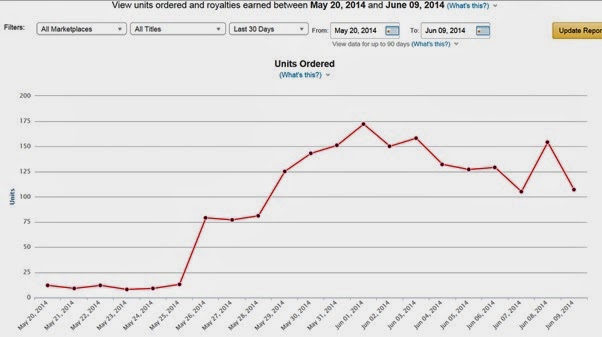
To give you some idea of how much money is involved in these rankings, first here's my sales for April 2014 (for all books in all Amazon markets) during a period when I had no freebies running.


Since I've released no new books this year, this gives a good idea of what my sales look like with no 'price juicing'.  [Non-Amazon sales are currently around a tenth of these amounts.]

And here are my sales for the fortnight or so following the 'Holy Grail' I mentioned earlier - a Bookbub promotion on the back of a free first book in a series.


You used to be able to do this just by setting your book free - way back in the dark ages of 2011.  Nowadays you only really get this big a boost using something like Bookbub (a free/cheap book alert service with several million subscribers).  Of course, it's becoming rather difficult to land a Bookbub promotion these days. ;)

Most of these sales are of Touchstone, which remains my best-selling series by far:

Amazon Sales - 1 June 2014 to 9 June 2014

Sadly, it's rare that price juicing has a permanent impact, but free is definitely a way to get your book out there and it's a hell of a rush to earn the equivalent of a book advance in a fortnight.  I gave away around 30,000 free copies of Stray this time (only a tiny fraction of those will ever be read), and will probably simply leave the book on permafree from now on.

And as the years go by, I slowly increase the numbers of 'my' readers out there - people who look specifically for my books and buy them when they're put out.  Not because of any price juicing or random encounter in the also-boughts list.  The career of a self-publisher can follow a very different path to trade authors (where pre-promotion and first week sales are so important).  Mine has been a slow build thing, but fun and interesting and a viable second income.

And most certainly not an endless grind of promotion.

07 February 2014

Poisoned Wells

There's been a bunch of articles lately about how the vast morass of terribly written self-published books on the market poison the well for all self-published authors.  Readers are being tricked by untrustworthy reviews into paying good money for incompetent work.  The dreckworthy quality of these books causes the reader to swear off self-published books, and Something Must Be Done.

These articles primarily come from trade published authors who claim to support self-publishing (while proclaiming the majority of it dreck), and usually produce irritated/angry responses from self-publishers (along with many reasoned arguments pointing out that bad videos haven't killed off YouTube and Snooki hasn't killed off trade publishing, etc, etc), which are then used as evidence that self-publishers are delusional, hostile and crazyballs and overreact so much when people tell them what's wrong with them.

It's not a particularly productive conversation.  Self-publishers are able to impact the quality of their own work, and maybe give some helpful feedback on the work of others if and when asked.  But the truly incompetent either never ask for feedback or (as I've seen) simply don't care even when a forum full of self-publishers point out that they have a dozen typos on their first page.  There already is a strong culture of "make your books better" among some self-publishers, while others are more interested in the latest trick for discoverability, and others still don't talk to any other self-publishers, but do their own thing.

The Borg has not yet gotten around to assimilating self-publishers.  There is no hive mind here.

Nor is this an argument anyone's going to win.  Some people won't read self-publishers.  Some people will.  Some self-publishers will put out good work.  Some self-publishers won't.  Some trade published books are good.  Some trade published books are used as the fall-back example of "trade publishing puts out bad books too!".  Some of those books make trade publishing millions of dollars.

One person's dreck is another person's doradango.

The majority of the books I read are trade published, but I'll happily buy self-published if I'm drawn by the cover, the blurb interests me and the sample's good.  I've never chosen books to read by who published them.  I'm undisturbed by the idea that some readers will never touch my books because I'm self-published.  They can join the readers who won't read my books because I'm a woman, or because they contain swearing, or the occasional bi-normative world.

Long story short: wow, there's been a lot of Chicken Little posts about self-publishing lately.

31 October 2013

Self-publishers and Posterity

The Library Journal's Annoyed Librarian column recently published an article, Self-publishing and Libraries, and a follow-up, For the Self-Publishers.  The gist of the first post is:
  • "Publishers are supposed to stand between the public and awful novels and “inspirational” works."
  • [Speculation about the motivations of self-publishers (which are presumably significantly different from trade published authors).]
  • "But with almost 400,000 self-published books a year, the amount bought or preserved by libraries is going to be negligible. In the future, it will be like the vast majority of these books never existed."
  • "Or maybe that’s true now. If an ebook is published in the wilderness and nobody reads it, does it still count as a book?"
The second post, responding to comments on the first post, covers the following:
  • Trade published books are not necessarily going to be better edited than a good quality self-published book.
  • Library users want the most popular books, not niche books.
  • Librarians rely on certain sources (Library Journal, Publisher's Weekly, etc) for reviews to allow them to make book purchase choices.
  • Librarians do not have the time or budget to evaluate quality individually, so a librarian is infinitely more likely to choose a trade published book which has been reviewed by a trusted source.  Most of these sources do not deal with self-publishers (or only do so on an exploitative payment basis).
These posts inspired the usual eye-rolling in self-published circles, but (ignoring the misplaced suggestion of self-pub = poor quality) their overall gist appears to me simple common sense.  There are a lot of books out there, and librarians usually have a limited budget and even less time to spend.  They're going to focus on popular, reviewed and 'trusted' books.

I disagree, however, on the question of posterity.

Print on demand and ebooks have completely altered the question of how long a book is remembered.  Unless the book world goes through another revolution, every book I release will be available for as long as I allow it to be available and then it will linger on on pirate sites and eventually public domain.  For as long as there is a version of the internet, my books will remain.

I already have over ten releases.  Each year (except for the ones where I am exceptionally slack), I will release a new book.  Physical copies of my books are purchased by readers who particularly like my work (or just prefer to read from paper).  Some of these will circulate to second hand book stores.  Two of my books have finalled in 'creditable' awards.  I am linked three times in Wikipedia, though probably don't quite meet the notability requirements to warrant a page of my own.

I've never been reviewed by Library Journal or Publisher's Weekly and don't really expect to be.  I have been reviewed by Sherwood Smith and Rachel Neumeier, and believe me, the Library Journal isn't going to make me squee nearly as much as the idea that People I Read Have Read Me.  It's possible for any of my books - new or already released - to become a break out hit, or at least a minor success, but even if I simply continue on at my mildly improving growth rate, I have still made tens of thousands of sales.  There are people who consider me an auto-buy author, which (along with re-reading) is one of the biggest compliments a writer can have.

I do not suggest, however, that libraries are irrelevant.  Libraries were my lifeblood, back when I was a kid in a poor family who got new books on occasions like birthdays, if I was lucky.  For a book-a-day girl like I was, libraries were essential.  And the collection of the libraries I had access to shaped me.  My libraries had lots of Norton and McCaffrey and McKinley and Jones, and thus for me science fiction and fantasy has always revolved around female writers.  I gather that some libraries somehow failed to have much if anything in the way of SFF written by women, and thus some people actually don't associate SFF with women.  [That's a hard idea for me to get my head around.]

For the kid I was, growing up in a family where you got books from the library or for your birthday or not at all, a writer not 'preserved' by a library would simply not exist.  But that kid still would have grown up, and transitioned to second hand stores, and then the luxury of buying brand new books on the day of release - sometimes in hardback!

And that was back then.  If I was myself, and ten, in 2013, that once-a-year gift would have been an ereader, and I would be fully appreciating Project Gutenberg, and the plethora of free ebooks used as promotional tools by publishers, and I would shamelessly download pirated books because, after all, it was the books which were my lifeblood, and libraries only the intravenous system which delivered them.

The system has grown.

I started this post because Flannery, Readventurer Extraordinaire, excitedly tweeted to me that she'd seen Stray sitting out on display at her local library. In the nearly four years since I first published a book, this is the first - the very first - time I've had an "in the wild" sighting of any of my books. I was so excited I demanded asked her to go take me a photo. So there we have it: my book in a library, ready to give some unsuspecting teen what Norton and McCaffrey and McKinley and Jones gave me.


Flannery checked the library system, and there are five copies of each of the Touchstone books, and four of And All the Stars. King County Library System is apparently the busiest in the US, and evidently has managed to spare a little bit of time and budget for the occasional self-publisher. [I suspect it was making the Cybils finals which may have triggered the purchase - that definitely did raise my profile generally.] What a lovely picture that is, Stray being a real book and not looking out of place at all.  My excitement demonstrates that libraries are still an important part of the system, but they're not the only part of the system.

My posterity's doing fine, thanks very much.

Edit: Now with a bonus picture of my books in Minette Public Library!  [Or some of them - the rest were apparently checked out!]

Gosh I write skinny books.

24 October 2013

Sales to Date

At the beginning of the year I noted that I'd hit 10,000 sales by the end of 2012.  Prompted by Patty Jansen's informative post, I've updated my figures for those interested in self-pub stats.

Sales by year:

(Date range is 1 December 2010 to 30 September 2013.  Freebies and not yet reported sales not included.)

Sales by store:

Amazon 17832
Apple 224 
Barnes & Noble 677 
BordersAU 2 
CreateSpace 437 
FNAC 4 
Kobo (via Smashwords) 42 
Kobo Writing Life 141 
LivrariaCultura 1 
Smashwords.com 347 
Sony 29 

Earnings:

I've been totting up last year's figures for my taxes (which run from 1 July to 30 June in Australia) and my (gross) royalty income looks to be around $16,600.  This is less than last financial year, despite what the sales numbers suggest - but mainly because Amazon pays by cheque about two months after you earn the money.

Popularity:

As you can see, The Touchstone Trilogy is still by far my most popular books.  Partly that's the power of series and first book freebies, but it's also simply very popular and gets very good word of mouth.  Stained Glass Monsters remains my least successful (ironic, given it's one of my favourites).

It wasn't until I'd totted these figures up that I could see that both And All the Stars and Hunting had performed quite well for stand alones.  Their numbers will no doubt drop off now we're well past their release dates, but I'd expect to continue to sell several hundred each year.

Sales Venues:

It would be nice to believe that sales will continue to improve at this rate, eventually giving me a comfortable income on which to write full time, but as Patty pointed out recently, self-publishing is a very unpredictable industry.  I was completely unaffected by the Kobo debacle - but as you can see it's not a primary market of mine.  [It will be interesting to see if that changes after a Kobo-related promotion I'm theoretically participating in at the end of the year.]

Like most self-publishers, Amazon is by far my best outlet.  Both Barnes & Noble and Apple improved this past year as a direct result of Bookbub, which is a cheap books notification service which has been one of the few effective promotion tools lately.

Future:

The big money in self-publishing tends to be in certain genres, and also in writing series.  Unfortunately I don't think I have the writing skills/style to do well in the big money genres (thrillers, romance and erotica can be difficult to write!), but I am at least writing series books this year.  Typically, I'm writing the beginnings of three series at once (while finishing off Bones) and the things I'm interested in writing tend to not match up with the types of books which become immensely popular.

But I am slowly finding a repeat audience.  And I'm having fun - which is probably what counts most for me. :)

04 September 2013

Paper and Ebook copy bundling

As you may or may not know, Amazon is launching something called Kindle MatchBook, where the paper copy of a book will be bundled with a discounted or free copy of the ebook.  This launches in October some time.

I saw no strong reason not to participate (I don't usually like to advantage one retailer over others, but my paper sales are very small compared to my ebook sales), so for those of you who buy paper copies and like to have e-copies, I've signed my books up for the ebook to be bundled free with the purchase of physical books available through Amazon.

13 April 2013

Managing the self-publisher's chip

When I'm asked about self-publishing vs trade publishing, I'll list strengths and weaknesses of both options, and strongly recommend Kristine Kathryn Rusch's "Business Rusch" series of blog posts.  Rusch is a hybrid author and has invaluable information on traps and issues which face both trade and self-published writers.  Even if you're intending to only follow a trade publishing path, reading Rusch (and her commenters) on issues with various contract clauses can potentially save you an infinite amount of grief.

But one thing Rusch doesn't cover in great detail is disdain.

Yes, attitudes towards self-publishing are changing, and self-publishers can put out books and try to gain an audience.  A tiny minority are stunningly successful (in the millions of dollars territory), a solid number are able to become full-time writers, and a far larger body hover around my level - enough that it's a viable second income, but not enough to give up the day job (rather like many trade published writers).  And there's plenty of people self-publishing who don't sell at all - either because they don't write very well, write in an extremely niche area, package their books poorly, or are just unlucky.  Self-publishing is no more a guaranteed path to success than that old saw: "If you write a good enough book, and keep submitting it, it will get published".

Even successful self-published books are often treated as "not good, just successful", and one thing most self-publishers have in common is the need to deal with scorn, hostility, derisive comments and - worst of all - complete indifference.

Many self-publishers have come from submitting their books to trade publishing and receiving either form rejections or frustrating "almosts".  Years of it.  Decades.  And going into self-publishing, they will face not only the apparently insurmountable task of interesting readers in their books, but also people who state "I don't read self-published books at all", or "I only read self-published books by trade published authors" and forums which (burned by a flood of over-the-top self-promotion) have strict "don't mention your books" rules.  And that's not even starting on the direct mocking.

Any person facing a long negative experience is likely to build up at least a small chip on their shoulder.  This past week demonstrated that even enormous success will not necessarily remove that chip.  Hugh Howey - one of the most successful self-publishers out there, with a major movie deal, a print-only book deal, and promotion which includes airport placement (ie. someone who is more successful than the vast majority of trade published writers) - posted a now-deleted blog entry entitled "The Bitch from Worldcon".

The blog post demonstrated two things: Howey has no comprehension of offensively gendered language, and Howey is carrying around an enormous 'self-publisher's chip'.  The story involves Howey playing incognito at a recent science fiction and fantasy convention, listening to a very rude person dismiss self-publishing, and gloating to himself (and later to his blog readers) over the secret knowledge of his own success, while indulging in a little power fantasy of, basically, rubbing his detractor's face in it.

Enormous success obviously hasn't made the resentment go away.  And the negativity toward self-publishing and self-publishers isn't going to go away either.  It's now just couched in terms which include "outliers" and "popular but bad" and "cult-like mentality" or "self-publishing is really really really hard and most of you will fail at it".  If you label yourself a self-publisher, the attitudes toward the group as a whole will shower down upon you, no matter your opinion of trade publishing, or the quality of your writing.

I'm not immune to self-publisher's chip.  It bugs me when people make statements about the quality of my books without having read them.  And I'm strongly aware of not being "part of the conversation" in the SFF world.  One of my clearest memories as a writer will always be the 2010 Aurealis Awards.  Sitting in a big auditorium full of people, watching my book's cover flash up on screen as a finalist for Best Fantasy Novel.  It was an amazing feeling.  And then I thought: "The only people in this entire room who have read that book are the judges."

Strategies for managing self-publisher's chip will vary from writer to writer, depending on the particular negativity being faced at the time.  I can only share the methods I use to keep that chip in check:

1. Focus on the good bits

I might not be a bestselling self-publisher, but in many ways I'm an incredibly fortunate one.  I've had some external validation thanks to those (highly discerning!) Aurealis judges, which in the worst moments I can point to and say: "See!  See!  Not rubbish!"

I have a small core of readers who have liked my work enough to consider themselves fans.  And they tell other people they should look at my books.  Or they just send me an email saying how much they liked them.  And that is an astonishingly wonderful thing.

I do read my negative reviews, but I save them up, get them over with like a dose of medicine, and move on.  Spending energy on negative reviews of your book is like stabbing yourself in the knee.

2. Care less about other people's decisions

Self-publishing is a wonderful option, but I don't evangelise it, and I accept that readers might use it as a criteria to winnow down the millions of books available to them.  Ultimately, it matters very little if a particular individual avoids self-publishing.

It's incredibly hard to do this when you're just starting out, and no-one is reading you.  It makes you feel like you'll never be read, that you're unfairly penalised, that it's all hopeless.  It will be even harder if your writing isn't quite there yet, and you've rushed to self-publishing perhaps before you're ready for a critical audience.  If nothing else, you can fall back on an "Hey, at least I have nice copies of my books on my bookshelf" attitude.

3. Don't try to be part of the conversation

This is probably the hardest one for me.  I like talking about SFF, and I'd certainly like to see my books considered part of the conversation in discussions of the genre, but one of the first lessons self-publishers learn is "don't talk about your own books outside your own blog".  I sometimes stray on this one - I'll see someone posting or tweeting: "I'm looking for SFF examples of X".  "There's hardly any SFF which does X, please someone give me examples!"  And eventually, against my better judgment, I'll be drawn in, and respond with two of three examples, including a book of my own which does precisely what the person is looking for.  And it seems like every time I do this, the person asking for examples will meticulously thank every single person for their suggestions - except for that pushy self-publisher, of course.

That's my chip in action.

4. Think long term

Self-publishing inverts the trade publishing model where pre-release buzz is built up, there's a mass burst of publicity on release, and the book has to sell sufficiently in its first year (or months) to keep the author's career alive.  If I judged my likely success on my first few months after release (where I sold only a handful of books), then I'd be an abject failure.  Except for the rare instant successes, self-publishers aren't really in a position to judge their careers for at least a couple of years.  And you never know if your next book might be your break out book, which in turn will juice your sluggishly selling backlist.

When I started I had an idea of a "five year plan". My first book went live in October 2010, so I won't really be able to judge how I'm going till October 2015, but the view from April 2013 is pretty good.

5. Next book?

Disinterest and occasional outbreaks of vitriol toward self-publishers are far easier for me to deal with than the immense negativity I suffered submitting books which never went anywhere, because it's balanced by lots of lovely positives.  And the biggest positive is the knowledge that there are readers out there waiting for my next book.

And so in conclusion I seem to be saying much the same as what most of the self-publishing advice posts say: The best thing to do is put your head down and write!

24 February 2013

Rescheduling

Hunting is now definitely bumped to a March release.

Hunting was the fifth book I wrote (after the various Talismans books and Lammersgach, which I have no intention of releasing because LOL).  It was the first book I put through a writing workshop, and I had lots of useful feedback and positive comments, and I'd also gone through to tighten the writing several times after its completion, so though there were some things I wanted to clarify with the worldbuilding, I figured four months was plenty to finalise it.

Hoo boy.

The plot's still solid, but two secondary characters and a sub-plot needed to go.  And a quarter of what was left needed complete rewriting.  [There's some particularly unconvincing dialogue.]  So, delays.

I've set the release date for 7 March 22 March 31 March 4 April.  I'll bump it again if I'm not satisfied, but I'm cautiously optimistic.

Not doing it just to torture you guys, promise.  My schedule is a victim of my own evolution as a writer. ;)

17 January 2013

10,000

I've been very belatedly adding up my numbers, and it seems that at the end of 2012 I hit 10,000 books sold.

To celebrate, I'm going to give away a copy of whatever book the winner chooses!  [Up to and including the doorstop hardcover edition of The Touchstone Trilogy.]  (If you happen to have all my released books, then an e- and/or pb copy of Hunting.)

Entries can be done using the rafflecopter below.

a Rafflecopter giveaway

15 December 2012

Advance Warning on Price Rises and current Status

Just giving advance warning that after Christmas I'll be lifting my prices from $3.99 to $4.99 per book. I don't think I'm ever likely to price my books in the "upper regions" (ie. $6-$10), but there's this interesting 'perception of quality' issue with books below a certain price. Since my sales have been generally sluggish since KDP Select came in (with its preferential promotion of exclusive books), I have some freedom to experiment with the price I originally intended, but kept hesitating on going to.

I've been a complete slacker with the editing of "Hunting" (I'm only about a third of the way through) and will have to light a fire under my tail. I'm actually a little nervous about the book's reception, since it's the 'earliest' of the books which I'm putting out (I wrote it before "Medair", though after about five other books which will never see the light of day) and it does read to me as "young". More straightforward plot, less deconstruction of the fantasy genre. Still, I love Ash, who has no special powers but an entertaining amount of self-belief.

I really don't want to delay the current publication date just because I've been playing too many MMO's, though, so will try to settle down to work.

23 November 2012

One Thousand Stars

After two years and two months, nine books and two compilations, I've hit one thousand ratings on Goodreads*!   I consider this a bit of an achievement, since it's no easy task getting people to read a complete unknown self-publisher, though from a trade publishing point of view - when a new release can easily hit a thousand ratings in two months - it's nothing spectacular.  Heck, some books get a thousand ratings before they're even released!

At the same time, I'm still a "slow and steady" sales type.  To give an idea of relative successes, Goodreads recently posted an article about the Goodreads recommendation engine.  The most interesting point was this:
In late April, the Goodreads Recommendation Engine picked up the book. On average, a book needs to have several hundred ratings before it starts to be included by our algorithm. From that point forward, it became the dominant way that Goodreads members discovered the book. That's the blue section you see in the graph.
So even with Stray's 228 ratings, I have a long way to go to even start to be recommended.  The recommendation engines over at Amazon are even more complex (with participation in Select, sadly, being extra helpful).

With And All the Stars only two months into release, it's not really possible for me to say how successful it is or isn't.  It had solid sales on release as my small established audience picked it up and devoured it, and has now settled into a 1-2 books a day sales pattern.

It's very difficult to tell whether the decision to place the book on NetGalley was worth the expense.  I now have many more book blog reviews for And All the Stars than I have for all except Stray, and it's certainly a much more graceful and pain-free way to get the book out there available for reviewers than emailing reviewers individually.  I'm sure I've picked up a few readers thanks to the various reviews I've received (all but a couple of which have been positive or very positive) and there is a chance that the gradual weight of these reviews will combine into genuine "buzz".  But the impact is still absolutely nothing compared to the sales I receive by making Stray free every six months or so,  Periodically making Stray free remains my best way of picking up new readers, with a small fraction of Touchstone readers moving across to my other books.  I probably won't use NetGalley again unless something changes, and just enjoy the smaller amount of reviews I gain naturally.

Hunting is more or less on track to be released in February.  I've changed quite a lot since I wrote this particular book, and in the editing process have so far removed two extraneous characters and spent more time on worldbuilding.  Hunting is actually the first in a series of four books, but I'm in two minds about publishing the rest of them - there's a plot development in book two which some people will hate, book three is only half-written, and book four is this endless sprawling and self-indulgent mass.  So, lots of work if I want to put them out.

Next year will be catching up on sequels to earlier-released fantasy - Bones of the Fair, which is a companion to Champion of the Rose, and focuses on Aspen and a new character.  BotF is almost complete, but needs thorough editing work.  Then The Sleeping Life, which is a sequel to Stained Glass Monsters and about half-done.  I'll also consider whether or not to slot Wellspring (my magic as a non-transportable commodity book) in at this point.

After that I'll be back to writing fresh stuff - Pyramids of London for a start - I've been doing some elaborate mental worldbuilding for that one and am looking forward to getting some of it on the page.  Then another book started thanks to Goodreads - talking about books generally gives me ideas about books, and in this case I ended up deciding I wanted to do some form of Space Opera MMO trapped in a virtual reality novel.  Very over the top space opera with space elves and a beginning section called The Drowned Earth and, well, I'm trying not to think about it all too much because I'll start writing it and throw my schedule out again.

I've actually written quite a bit of space opera/space adventure, but for some reason I always hit a wall and stop around chapter 12.  There's Surrogate, my "space naga smut book".  And Runes, which is rather plainly influenced by Andre Norton's Forerunners - lots of space archeology and ancient working tech.  And Solitary Stars, where a survey pilot gets kidnapped off on a hunt for, again, a Forerunner planet.  And then there's the one which I think I actually called Space Elves, with blue-skinned, pointy-eared people insisting on fighting duels all over the place, much to the dismay of this long-suffering space station cop.

I love non-scientific, over-the-top space adventure, but damned if I ever seem to finish it.

Anyways, here's to the next thousand stars**!

* [26 of these ratings are for a book which I haven't even released yet, but oh well.]
**[Technically it's more like four and a quarter thousand stars, but that's not so catchy a title.] *

12 November 2012

Some of the people some of the time...

I'm occasionally asked whether I would recommend self-publishing, and usually reel off a list of pros and cons, noting that it's not an either-or decision, but an option you can take without longing for the downfall of trade publishing.  I'll point out that it's fairly easy to get the books up from a technical perspective, that there's companies which will do it for you for a flat fee if you're not great with computers, and that there's no obligation to spend any time marketing (nor, indeed, any guarantee that spending any time marketing will impact your sales significantly).

Putting your work up to be either ignored or judged is a different sort of challenge, but not unique to self-publishing.

One thing which is almost guaranteed to come along with the decision to self-publish are two words: Needs Editing.

Rather too many self-publishers type their books out and throw them up raw.  Some self-edit.  Some crowd-source or trade editing with other writers.  Some hire editors, and make sure to list those editors up front and central in the book's metadata.  Sometimes those editors will be capable and talented people, and sometimes (as apparently was the case with Amanda Hocking's hired editors) not so much.

The copy-editing side of this process - eliminating typos and grammar errors and spotting continuity issues - is relatively straightforward (though even then you will find yourself coming up against grammar myths or "spelling errors" based on British/US/Australian English differences).  But it's fairly easy to say that a book has few spelling or grammar issues.*

Developmental editing - consistency of characterisation, issues with pace, recommending changing point of view, boosting the role of a character, gender-flipping the protagonist, or even altering how the book ends to produce a satisfying and powerful reading experience - all those are a little less definitive.

A developmental editor is a highly experienced reader who can push you into seeing how to make your book even better.  In their view.

Here are two reader views of the opening of Stray.

Love love loved the beginning survivalist part! And the worldbuilding was incredible, though I think some of the humor I liked so much, as well as the characterization, got a bit lost in the last half. - Wendy Darling

I really enjoyed this book. It was slow going to get into it but I'm glad I stuck it out. The story picks up momentum almost imperceptibly and after about 100 pages becomes 'unputdownable'. -
So which editor did I get?  The one who thought that beginning survivalist part was brilliant, and wanted more like it, or the one who thought that part was dull, and fell in love with the book later on?

No book is the same from one reader to the next.  No editor can polish your book to be "perfect".  Experience and personal taste will combine to produce advice which will please some of the people some of the time, and maybe even lots of people most of the time, but never ever all of the people all of the time.

This isn't a suggestion to not use editors.  Feedback on your writing is incredibly valuable, allowing you to see the book through different eyes.  But no matter how much editing your books have gone through, you will not please all of the people all of the time, and because you're self-published you will be told that your books Need Editing.

This will be un-fun at times, and possibly the person saying that is simply not one of "your readers", far more interested in action than character development, or vice versa, but it's also useful free feedback, giving you more things to look for when your next novel is going through the editing rounds.

I'll finish this off with two quotes from Diana Wynne Jones about editing.  First a positive one:

On the good side, there are enormously high standards.  None of the editors I have worked with would have accepted much in the way of clichés.  None of them have ever let me get away with any muddle in any plot, nor with any factual inaccuracy; and though some have queried things that struck them as peculiar, they have always been delighted by originality.  This naturally has put me on my mettle.  Knowing that everything I wrote was going to be subjected to extreme and shrewd scrutiny, I take pains to get the finished manuscript right, if I can.

Then a cautionary one:

I hate being edited, because my second draft is as careful as I can get it.  I try to get it absolutely mistake-free, and absolutely as I feel the book needs to be.  Then some editor comes along and says, 'Change Chapter Eight to Chapter Five, take a huge lump out of Chapter Nine, and let's cut Chapter One altogether.'  And you think, No, I'm going to hit the ceiling any moment.  Then I call for my agent before I get my hands round this person's throat.

Editors were very majestic in the days when I first started writing.  There was one who got hold of The Ogre Downstairs, and rewrote the ending entirely in her own purple prose, which was not in the least like mine, and I decided I was going to change publishers.  'No, no, no,' said my agent.  'You mustn't do that. Carry on and see if you can manage to persuade her.'  And of course I couldn't persuade her.  And then Charmed Life: I know by the time I'd done the second draft it was absolutely perfect, it really, really was, I mean just as it is at this moment, you know.  And this woman rang me up and wrote to me and told me exactly this sort of thing: 'You must take out this chunk and that chunk and rewrite this and alter that,' and I was furious.  And I thought surely we can do something about this.  And thank God it was the days before computers.  I said, 'Send me the typescript back and I'll see what I can do.'  So she did, and I cut out the bits she told me to alter, in irregular jagged shapes, then stuck them back in exactly the same place with Sellotape, only crooked, so it looked as if I'd taken pieces out and put new pieces in.  And then I sent it back to her, and she rang up and said, 'Oh, your alterations have made such a difference.'  And I thought, 'Right! Hereafter I will take no notice of anybody who tries to edit my books.' And I don't,  I make a frightful fuss if anybody tries to, now. - Reflections on the Magic of Writing.
An editor can be a very useful person to have on your side.  But they're not a magical guarantee of perfection, and they're not unique to trade publishing.  Always listen to, then weigh and evaluate any feedback on your writing.  And don't let the 'slings and arrows' get you down.  A small press editor once told me that it simply wasn't possible for a self-published book to be as good as a trade published book, but I've yet to hear a believable argument as to why this should be.

* I've never put a book out which didn't have a typo (still waiting for someone to spot one in And All the Stars, but it's sure to come), but I'm at around 99.5% correct and aiming for better.

22 October 2012

Portal-keeping

I don't usually indulge in the rah-rah-down with gatekeepers blah-de-blah which so many people associate with self-publishing.  Trade publishing has brought me many good books and I hope that it continues to do so.

But.

Reading this discussion about portal fantasy on Rachel Manija Brown's livejournal has made me at least briefly pick up the pom-poms and start cheering.  Ms Brown starts the post out with:
Yesterday there was a fascinating discussion of portal fantasy, in which a character from our world is transported to another world. The classic example of this is Narnia. I can’t link to the post, because it was filtered (the “portal fantasy” discussion was in the comments) but I offered to make a public post on the subject. I invite the participants to copy their comments to it.

There was a Sirens panel in which five agents, who were discussing their slush piles, mentioned that they were getting quite a few portal fantasy submissions. Two of them said those made up about a quarter of their total YA fantasy submissions.

I said, "This intrigues me, because I haven't seen a single one in the last ten years. Is it that editors aren't buying them? Did you pick any up?"

The agents replied that none of them had even requested a full manuscript for a single portal fantasy.

They explained that portal fantasies tend to have no stakes because they're not connected enough to our world. While in theory, a portal fantasy could have the fate of both our world and the other world at stake, in practice, the story is usually just about the fantasy world. The fate of the real world is not affected by the events of the story, and there is no reason for readers to care what happens to a fantasy world.

One agent remarked that if the protagonist didn't fall through the portal, there would be no story.

And, of course, I was thinking Stray.  I never submitted Stray to any publishers or agents, not because it was portal fantasy, but because it was in diary format, deliberately rambly, and written originally in blog form.

I had no idea that the biggest bar against it was that it was portal fantasy.

An entire sub-genre.  A sub-genre which is the basis for some of the most popular and enduring stories we have (from Narnia to Oz).  And both levels of 'gatekeepers' were automatically not interested, had declared the sub-genre dead - and not told anyone.

I've had plenty of opportunity to fully appreciate the frustrations of the submission-go-round, and I'm so glad that this particular bullet is one I dodged.

The Touchstone Trilogy remains my most popular story.  People read it end to end, and start over.  I had one reader tell me it got her into reading science fiction.  She went on from me to McCaffrey!

So, yeah, rah rah self-publishing.  Here's to having multiple options, to that internet-wide hole in the fence beside that gate.

30 March 2012

The Power of What Happens Next

My main interest in reading is plot.  I like to find out what happens next.  I read stories where the blurb suggests a story I will enjoy, or where it's an author whose other stories I've enjoyed.  I do re-read, but I have to be drawn by a love of a particular character or facet or the writer's voice or some such to revisit a story (though it helps that I have a shockingly bad memory).

There was one particular book - fifth in the latest series of an author I'd followed for years.  She wasn't an absolute favourite, or a re-read author, but I'd enjoyed all the books so far.  The blurb told me this latest book was about two characters - one who is kidnapped by zealots and has to survive, and the other who is blamed for the kidnap and has to mastermind a rescue.

So I read.  And read.  And I'm feeling bored, and wondering why.  And I read, and I'm irritated, and I'm halfway through the book, and by this stage I'm skimming, and I end up flipping through in big chunks, and was left dissatisfied and annoyed.

I've never read that author again.  And it wasn't even her fault.  It was the blurb.

In as much as I take writing advice, one of the pieces of advice I seem to have taken to heart is "The beginning of your story is the event - large or small - where your character(s) life changes".  So Medair starts when Decians interrupt her sulking fit on Bariback Mountain.  Champion begins with the discovery of a new rose, transforming Soren from curiosity to someone required to be important.  Stained Glass Monsters is the moment when a woman in white appears mysteriously in a field.

The first line of the blurb for Stray is: "On her last day of high school, Cassandra Devlin walked out of exams and into a forest."  The first line of the book is Cass's reaction to being on Muina.

Now I could have spent some time establishing what Cass was like at home first.  Fun scenes of Cass and Jules squabbling over the remote control, and Cass and her best friend plotting to win Nick's heart, and Cass preparing for exams.  Cass sitting her English exam.  Cass trying to decide what university she wanted to go to.  Cass sitting her Geography exam.

Imagine that going on for half the book.  Longer.  How long till you started skimming?  In the book of that now-abandoned author, the kidnapping happens three-quarters of the way through the book.

Blurbs can make or break a book - not just for selling the story in the first place, but for setting reader expectations on what the story is about.

Although I'm not outstanding at writing blurbs, every time I remember that kidnapping book, I'm endlessly, boundlessly glad I can control what goes into mine.
The blurb for And All the Stars is a prime example:

Madeleine Cost is working to become the youngest person ever to win the Archibald Prize for portraiture. Her elusive cousin Tyler is the perfect subject: androgynous, beautiful, and famous. All she needs to do is pin him down for the sittings. 
None of her plans factored in the spires: featureless, impossible, spearing into the hearts of cities across the world – and spraying clouds of sparkling dust into the wind.
Is it an alien invasion? Germ warfare?  They are questions everyone on Earth would like answered, but Madeleine has a more immediate problem. At Ground Zero of the Sydney spire, beneath the collapsed ruin of St James Station, she must make it to the surface before she can hope to find out if the world is ending
And this (still to be polished a little) is how the story opens:
Madeleine Cost lay on her side, wedged between an upright and a diagonal. Dull pain marked upper shoulder, hip, thigh. A different hurt pounded her skull. She felt dusty all over, grimed with it, except her lower half, which was wet. Getting wetter.

With a jerk Madeleine came fully awake, cracking her head against the diagonal above. Stars blossomed in the dark, and she lay and gasped until she could dare to do more.
Her world was a tight, close space: a triangle tilted so that her head was lower than her feet. A glimmer of light reflected off metal, not enough to give any details. There was barely room to squeeze one hand past the slick surface, to cautiously explore her face, her skull, and find powdery dust and a throbbing lump.  Free-flowing liquid was draining past her head. She could hear it falling. 
She could smell blood.
The blurb introduces you to the main character, tells the reader something which is learnt in the second chapter, and drops you right into the situation as described.  So, can you tell me what's going to happen three-quarters of the way through the book?

Seriously.

04 January 2012

One Year In (and a bit) as a Self-Pub

I've now been (self-)published for a year and a month.  My bibliography boasts ten whole books (including compilations).

Being a self-published author can be a strange experience.  By self-publishing, I attached a label to myself.  I've found that if I'm not careful a set of opinions and attitudes will be ascribed to me purely because I'm self-published.

I'm not someone who runs around predicting and celebrating the imminent collapse of some hidebound traditional publishing monolith.  Most of the books I buy are put out by 'traditional' publishers and (while the industry does have issues) I fully expect it to adapt to the changes and continue to produce books I want to buy.  [Hopefully the basic contracts offered to authors will improve, but the industry as a whole isn't a bad thing.]

I'm also not someone looking for a publishing contract.  I love the freedom of self-publishing.  I love not having to leap through hoops to get my books out there, to not be in the position of, basically, begging for a chance to tell my stories.

Sure there's some un-fun facets of self-publishing.  It's always a strange experience to be reading through an enjoyable blog or article and to run up against "If it was worth publishing, it would have been published" attitude.  Or "people who self-publish are too impatient to 'pay their dues'".  Or "I've never read a self-published book which I thought should have been published".  Not to mention the seemingly insurmountable issue of obscurity and reviews.  If you pursue reviews, you can find yourself as much a petitioner for reviews as you were for publication.

To many readers I am not a "real" author, or I'm an author with an "approach with caution" tag - one whose books will only be read on direct personal recommendation from trusted fellow readers.

But I've still found an audience.

I've sold over three thousand ebooks (which is a relatively small amount to some, but still seems an enormous number to me).  I've received reviews and ratings ranging from one-star to five-star.  I've had actual fan mail.  I was shortlisted for an award.  My sales reached their high point in November and have dropped a fair deal since then, but I am still steadily selling, and every day or two I come across another review which makes me smile (or grind my teeth, or groan).

It has been - and continues to be - a blast.

Excuses, excuses

My Steam history might explain why there's no new book this year, but it's more just reading.  I've been exceptionally inclined...