The Core RPG Kickstarter is humming along nicely - looks like if support continues the tier that involves Touchstone will be hit in the next week or so!
Watching the process is bringing back a lot of RPG memories. I started roleplaying in university and played through quite a few different systems - original rules D&D and then advanced editions. Vampire: the Masquerade. TORG. Paranoia. My friends created their own system, adaptable to any setting, and Core reminds me very much of that, of the focus on the story and taking settings and running with them.
I eventually drew back from roleplaying because the stories could get too interesting, and I started thinking about the RPG world instead of my own. My friends were way too good at telling stories!
I still have quite a few old character sheets lying about, and was admiring the little business card sized sheets of the Core system (not least for the very cool picture).
With a dice function on my phone and my character sheet tucked into a pocket of the phone case, I'd be ready to play whenever.
13 July 2014
08 July 2014
A kickstarter for the roleplaying Touchstone fans
For those of you who like a bit of tabletop RPG, you're sure to be interested in the Core Rules Kickstarter. Created by Origin Award-winning game designer Lester Smith, the Core Rules system combines easy character creation with the settings of books, giving you both mechanics and worlds to fool around with.
Touchstone comes in on the Sci-Fi setting level, and if the Kickstarter reaches that level you'll get the basic systems of the Touchstone Trilogy as part of the settings guides (ie. a breakdown of the powers, the places, and the types of missions available). [And I'll get to write that part of the setting guide! ;) ]
I'm not otherwise involved with the Core Rules or Popcorn Press, but for those who loved the world of Touchstone and want to play around in it (or just like tabletop gaming and can never have too many rulebooks!), check it out!
17 June 2014
Interview: KS Augustin
In the past couple of years I've sampled several different urban fantasy
series, and the one that stood out for me - capturing my interest and keeping
me reading - was the Check Your Luck
Agency series. Discovering a wealth
of further titles by the same author (I'm dipping into the Qolari Diplomatic Corps series next), I thought I'd try my hand at
amateur interviewer and see how self-publishing and science fiction are treating
Malaysian-resident KS (Kaz) Augustin (aka Cara d'Bastian).
Q. I first came across your books with the urban fantasy Check Your Luck Agency series (set in Malaysia and Singapore and published as Cara d'Bastian). One of the things I really enjoyed was not only discovering a wealth of mythology, but also a resident's-eye view of two countries that rarely seem to feature in genre novels – I've read more SF set on the moon than the majority of countries on Earth. How do you feel about self-publishing opening up genre settings and stories?
A. Well,
firstly, thanks for inviting me here, Andrea. :) Put plainly, the Check Your Luck series would never have
seen the light of day if it weren't for self-publishing. Traditional publishing
still seems very parochial to me, rehashing the same ideas in the same settings
over and over again. (You see it in North American movies too. Take just the SF
genre. Oh goody, we have (a) a weatherboard house, (b) a corn field, (c)
strange lights hovering over a rural landscape, (d) two people looking skyward
at some point, hand-holding optional. You saw it in Star Trek, Superman, Signs,
Dave and a heap of others. Even the latest, Interstellar, has it. Can I say
that corn fields have officially jumped the shark?
Anyway,
getting back to self-publishing. :) Because so many traditional mega-enterprises
in the entertainment industries play it safe and rehash the same imagery,
anything that's even slightly different doesn't seem to get a look-in. And,
when it does, it gets treated shabbily; e.g. Cindy Pon and Barry Hughart with
their Chinese-setting fantasies. Being a career writer is hard enough, imo,
without bearing additional difficulties from bean-counters and marketeers. I
swear, if it wasn't for self-publishing, I'd be clinically insane by now! For
other writers, self-pubbing means they can take a chance, be daring and it's my
feeling the diversity can only benefit readers (and I include myself in that
group).
Q. Your work ranges from space opera, urban fantasy, contemporary stories set in south-east Asia, and SF romance. Is there one sub-genre that's particularly close to your heart?
A. Oh it's space opera. I adore space opera. It's big and dramatic and beautiful and awe-inspiring, all set against an even bigger, more dramatic and more beautiful universe. I'm a huge fan of opera, so it's no surprise that space opera really hits my buttons--the characters, the settings, the moral dilemmas, the pits of despair, the heights of exultation. What's there not to like?
Q. Last year you launched the Sci-Fi Romance Quarterly Magazine. Do you find it a challenge to juggle the slush pile with your own writing? What's your favourite aspect of taking on this new challenge?
A. Luckily (or through cunning planning), there are three of us working on this venture. Heather Massey handles the columnists and the new releases; Diane Dooley is in charge of the slush, although it does briefly pass through my hands on the way to her, and I'm the technical-wallah, basically. We put SFRQ together in an effort to highlight the sub-genre and get a community going.
My favourite part of it is the building. As long as I'm "building" something within the parameters of the magazine, I'm happy. Take Issue 3. As part of a cross-fertilisation effort, Ian Sales' "SF Mistressworks" site has partnered with us. SF Mistressworks is a wonderful initiative, bringing prominence to speculative fiction written by women before 2000. There's a lot more around that one would think and SFRQ now has the opportunity to showcase that.
We're also selective about who we invite to write opinion pieces for us, and prefer the feisty perspectives to more placid ones, even if they disagree with our own personal views. It's the dialogue aspect that's key. In the background, I'm trying to reach out to as many other female SF/SFR communities as I can to invite them to join us. I think it helps that I'm not North American as I'm not blinkered by it although, to be fair, both Heather and Diane are always carping on about "international inclusion" as well. ;)
Q. One thing many people don't know is that Amazon displays different books (and prices) to different countries. In some countries they charge a 'Whispernet' surcharge, and in others they won't sell books at all. I've heard you mention that as a self-publisher using Amazon's KDP, you cannot actually see your own books on Amazon. How frustrating! Are there other regional challenges that you've faced as a self-publisher?
A. Yes. That was the case back in 2011 when I started Sandal Press and it's still the case now. I can only get to my books "sideways" via the KDP dashboard or Amazon Australia/UK. I'm IP-blocked from accessing information on my books at Amazon US. They won't even display! As far as a south-east Asian reader is concerned, I don't even exist on Amazon, which is sad.
A lot of people get sidelined by the "Kindle available in more than 150 countries!" statement, without thinking what countries they are. Let's be honest here: does an author really believe she's going to sell more of her English-language books in Cambodia (inside Amazon ecosystem; approx. 1.5M English speakers; nominal GDP US$1,015 per capita) as opposed to Singapore/Malaysia (outside Amazon ecosystem; >10M English speakers; nominal GDP US$51,700 / US$10,400). You see, a single number, without context, is useless. So, yes, I was initially very frustrated with not being able to promote my books to the local market. That has since changed, and why that is has to do with the next question!
Q. How are ebooks taking off in the Singapore/Malaysia region? Are there local platforms springing up, or is the main focus the big multi-nationals?
A. Ebook readers are very expensive here, even with the GDP numbers I've given above (Wikipedia, so take them with a grain of salt, but they're still in the ballpark). I bought my husband and I Kobo ereaders and had to get them shipped from Hong Kong! They're just not available locally. There's a site called "Kindle Malaysia" that recently started selling Kindles (and ways to get around the IP blocking), but the prices are unbelievable. A Kindle Paperwhite that retails for $119 at Amazon US retails for RM740 (with a RM10 case). This equates to US$230, or almost double the price!
The local
etailer is e-Sentral.com but, with basic ereaders so inaccessible/expensive, I
can't see them making any kind of dent in the market. From what I read in the
papers, most people prefer playing "Candy Crush"!
In addition, I have spent the last year speaking with publishers and distributors across the two countries and, to put it bluntly, I don't write the kind of books that readers want to read. I've been told repeatedly that the Check Your Luck omnibus is too long. People are too busy to read such big books! As for SF, the average reader doesn't even know what speculative fiction is. (Of course there are exceptions, but I'm talking about general trends here.) And the bestsellers break down into either short (<200pp) books full of ghost/"real story" vignettes or get-rich and cookery non-fiction. There is also very much a "nostalgia" element to all this. Readers appear to prefer looking back ("the good ole days", "the trials of WWII occupation", "kampung (village) life") rather than looking forward. Self-publishing is a viable option, and there are a lot of small regional presses throughout south-east Asia, but the books only seem to do well within the parameters I've stated. Oh, and school workbooks. I've been told they are major revenue streams for most local presses.
Q. What's the best thing you've encountered in the new self-publishing paradigm? What's the most difficult to deal with?
A. The best thing is the control. Everything is down to me (and now my husband J, who has also joined Sandal Press in an administrative capacity), and I like that. I was able to vet, and pick, my own editors, get the covers I want, change them when I want, and set my own pricing. Being a Type-A person, this is heaven to me!
The most difficult is getting exposure. When J and I sat down to plan and create Sandal Press, I told him bluntly that this wasn't going to be an instant-riches scenario. I was figuring a ten-year horizon before we would begin to build up enough of a reputation to make money to live off. He was, and is, fine with that, but I find I'm the one who's being impatient. I've got to constantly tell myself to keep it steady, keep writing, read more, stay informed and keep writing. Sandal Press will be three years old in August, so I have seven years to go! I'm gritting my teeth. As you've probably guessed, I'm not a naturally patient person.
Q. And, finally, what's coming up for you in the new release front? :D
A. My biggest
enemy is time. Besides the SFRQ magazine, I also homeschool our two teenage
children, so that really eats into my writing--not that I'd have it any other
way, I hasten to add. I think homeschooling is a wonderful way to build solid
relationships with your children while learning together at a faster pace than
a normal school can provide. Our 12yo daughter, for example, taught herself the
Alice scripting language on her own time and J is teaching both kids how to
program in C on Linux. They haven't been told it's "difficult" or
"too advanced" or that my daughter will run into problems
"because she's a girl", so they're just getting down and doing it! I
think that's wonderful.
But back to your question. :) In no particular order, I need to finish my Perdition galactic empire space opera series (three books down, three to go), continue my Qolari Diplomatic Corps series (assassin space opera) and I'm currently working on a book that's outside my usual Republic and Fusion universes. I have a fantasy series I'm eager to start within the next two to three years, maybe some more Check Your Luck books (eh, Andrea?), and a near-future SF thriller series that keeps kicking around in my head.
In the immediate future, Quinten's Choice (Perdition #3) should be out in July; Guarding His Body (a contemporary romance reissue) is slated for September; Project Restoration (an SFR short novel) should also be out in September/October; The Siege of Olim (Qolari Diplomatic Corps #2) should be released around November/December; and Quinten's Gamble (Perdition #4) is pencilled in for early next year. That's the plan, anyway. We'll see whether I can stick to it.
Thank you
Kaz! For those interested in sampling
Kaz's work, you can find more detail on:
-The Sandal Press home page, blog and Twitter.
Q. I first came across your books with the urban fantasy Check Your Luck Agency series (set in Malaysia and Singapore and published as Cara d'Bastian). One of the things I really enjoyed was not only discovering a wealth of mythology, but also a resident's-eye view of two countries that rarely seem to feature in genre novels – I've read more SF set on the moon than the majority of countries on Earth. How do you feel about self-publishing opening up genre settings and stories?
A. Well,
firstly, thanks for inviting me here, Andrea. :) Put plainly, the Check Your Luck series would never have
seen the light of day if it weren't for self-publishing. Traditional publishing
still seems very parochial to me, rehashing the same ideas in the same settings
over and over again. (You see it in North American movies too. Take just the SF
genre. Oh goody, we have (a) a weatherboard house, (b) a corn field, (c)
strange lights hovering over a rural landscape, (d) two people looking skyward
at some point, hand-holding optional. You saw it in Star Trek, Superman, Signs,
Dave and a heap of others. Even the latest, Interstellar, has it. Can I say
that corn fields have officially jumped the shark?
Anyway,
getting back to self-publishing. :) Because so many traditional mega-enterprises
in the entertainment industries play it safe and rehash the same imagery,
anything that's even slightly different doesn't seem to get a look-in. And,
when it does, it gets treated shabbily; e.g. Cindy Pon and Barry Hughart with
their Chinese-setting fantasies. Being a career writer is hard enough, imo,
without bearing additional difficulties from bean-counters and marketeers. I
swear, if it wasn't for self-publishing, I'd be clinically insane by now! For
other writers, self-pubbing means they can take a chance, be daring and it's my
feeling the diversity can only benefit readers (and I include myself in that
group).Q. Your work ranges from space opera, urban fantasy, contemporary stories set in south-east Asia, and SF romance. Is there one sub-genre that's particularly close to your heart?
A. Oh it's space opera. I adore space opera. It's big and dramatic and beautiful and awe-inspiring, all set against an even bigger, more dramatic and more beautiful universe. I'm a huge fan of opera, so it's no surprise that space opera really hits my buttons--the characters, the settings, the moral dilemmas, the pits of despair, the heights of exultation. What's there not to like?
Q. Last year you launched the Sci-Fi Romance Quarterly Magazine. Do you find it a challenge to juggle the slush pile with your own writing? What's your favourite aspect of taking on this new challenge?
A. Luckily (or through cunning planning), there are three of us working on this venture. Heather Massey handles the columnists and the new releases; Diane Dooley is in charge of the slush, although it does briefly pass through my hands on the way to her, and I'm the technical-wallah, basically. We put SFRQ together in an effort to highlight the sub-genre and get a community going.
My favourite part of it is the building. As long as I'm "building" something within the parameters of the magazine, I'm happy. Take Issue 3. As part of a cross-fertilisation effort, Ian Sales' "SF Mistressworks" site has partnered with us. SF Mistressworks is a wonderful initiative, bringing prominence to speculative fiction written by women before 2000. There's a lot more around that one would think and SFRQ now has the opportunity to showcase that.
We're also selective about who we invite to write opinion pieces for us, and prefer the feisty perspectives to more placid ones, even if they disagree with our own personal views. It's the dialogue aspect that's key. In the background, I'm trying to reach out to as many other female SF/SFR communities as I can to invite them to join us. I think it helps that I'm not North American as I'm not blinkered by it although, to be fair, both Heather and Diane are always carping on about "international inclusion" as well. ;)
Q. One thing many people don't know is that Amazon displays different books (and prices) to different countries. In some countries they charge a 'Whispernet' surcharge, and in others they won't sell books at all. I've heard you mention that as a self-publisher using Amazon's KDP, you cannot actually see your own books on Amazon. How frustrating! Are there other regional challenges that you've faced as a self-publisher?
A. Yes. That was the case back in 2011 when I started Sandal Press and it's still the case now. I can only get to my books "sideways" via the KDP dashboard or Amazon Australia/UK. I'm IP-blocked from accessing information on my books at Amazon US. They won't even display! As far as a south-east Asian reader is concerned, I don't even exist on Amazon, which is sad.
A lot of people get sidelined by the "Kindle available in more than 150 countries!" statement, without thinking what countries they are. Let's be honest here: does an author really believe she's going to sell more of her English-language books in Cambodia (inside Amazon ecosystem; approx. 1.5M English speakers; nominal GDP US$1,015 per capita) as opposed to Singapore/Malaysia (outside Amazon ecosystem; >10M English speakers; nominal GDP US$51,700 / US$10,400). You see, a single number, without context, is useless. So, yes, I was initially very frustrated with not being able to promote my books to the local market. That has since changed, and why that is has to do with the next question!
Q. How are ebooks taking off in the Singapore/Malaysia region? Are there local platforms springing up, or is the main focus the big multi-nationals?
A. Ebook readers are very expensive here, even with the GDP numbers I've given above (Wikipedia, so take them with a grain of salt, but they're still in the ballpark). I bought my husband and I Kobo ereaders and had to get them shipped from Hong Kong! They're just not available locally. There's a site called "Kindle Malaysia" that recently started selling Kindles (and ways to get around the IP blocking), but the prices are unbelievable. A Kindle Paperwhite that retails for $119 at Amazon US retails for RM740 (with a RM10 case). This equates to US$230, or almost double the price!
The local
etailer is e-Sentral.com but, with basic ereaders so inaccessible/expensive, I
can't see them making any kind of dent in the market. From what I read in the
papers, most people prefer playing "Candy Crush"!In addition, I have spent the last year speaking with publishers and distributors across the two countries and, to put it bluntly, I don't write the kind of books that readers want to read. I've been told repeatedly that the Check Your Luck omnibus is too long. People are too busy to read such big books! As for SF, the average reader doesn't even know what speculative fiction is. (Of course there are exceptions, but I'm talking about general trends here.) And the bestsellers break down into either short (<200pp) books full of ghost/"real story" vignettes or get-rich and cookery non-fiction. There is also very much a "nostalgia" element to all this. Readers appear to prefer looking back ("the good ole days", "the trials of WWII occupation", "kampung (village) life") rather than looking forward. Self-publishing is a viable option, and there are a lot of small regional presses throughout south-east Asia, but the books only seem to do well within the parameters I've stated. Oh, and school workbooks. I've been told they are major revenue streams for most local presses.
Q. What's the best thing you've encountered in the new self-publishing paradigm? What's the most difficult to deal with?
A. The best thing is the control. Everything is down to me (and now my husband J, who has also joined Sandal Press in an administrative capacity), and I like that. I was able to vet, and pick, my own editors, get the covers I want, change them when I want, and set my own pricing. Being a Type-A person, this is heaven to me!
The most difficult is getting exposure. When J and I sat down to plan and create Sandal Press, I told him bluntly that this wasn't going to be an instant-riches scenario. I was figuring a ten-year horizon before we would begin to build up enough of a reputation to make money to live off. He was, and is, fine with that, but I find I'm the one who's being impatient. I've got to constantly tell myself to keep it steady, keep writing, read more, stay informed and keep writing. Sandal Press will be three years old in August, so I have seven years to go! I'm gritting my teeth. As you've probably guessed, I'm not a naturally patient person.
Q. And, finally, what's coming up for you in the new release front? :D
A. My biggest
enemy is time. Besides the SFRQ magazine, I also homeschool our two teenage
children, so that really eats into my writing--not that I'd have it any other
way, I hasten to add. I think homeschooling is a wonderful way to build solid
relationships with your children while learning together at a faster pace than
a normal school can provide. Our 12yo daughter, for example, taught herself the
Alice scripting language on her own time and J is teaching both kids how to
program in C on Linux. They haven't been told it's "difficult" or
"too advanced" or that my daughter will run into problems
"because she's a girl", so they're just getting down and doing it! I
think that's wonderful.But back to your question. :) In no particular order, I need to finish my Perdition galactic empire space opera series (three books down, three to go), continue my Qolari Diplomatic Corps series (assassin space opera) and I'm currently working on a book that's outside my usual Republic and Fusion universes. I have a fantasy series I'm eager to start within the next two to three years, maybe some more Check Your Luck books (eh, Andrea?), and a near-future SF thriller series that keeps kicking around in my head.
In the immediate future, Quinten's Choice (Perdition #3) should be out in July; Guarding His Body (a contemporary romance reissue) is slated for September; Project Restoration (an SFR short novel) should also be out in September/October; The Siege of Olim (Qolari Diplomatic Corps #2) should be released around November/December; and Quinten's Gamble (Perdition #4) is pencilled in for early next year. That's the plan, anyway. We'll see whether I can stick to it.
Thank you
Kaz! For those interested in sampling
Kaz's work, you can find more detail on:-The Sandal Press home page, blog and Twitter.
-Kaz's personal site and blog.
10 June 2014
Anatomy of a Promo
My approach to self-publishing involves very little promotion. I did submit my books to a small handful of book bloggers way back when I was starting out (and was very fortunate that one of them was The Book Smugglers!). Along with the enormously generous support I've received from other writers, book blogger reviews have definitely made readers more inclined to pick up my books.
However, for the newbie author with no rep at all, no word-of-mouth, there is one primary method to build sales:
- Write and release books.
- Make one free (particularly first-in-series).
- Get buoyed along by 'also boughts' and bestseller lists.
- Build fans/mailing list/newsletters.
- Rinse/repeat, along with judicious use of that year's Holy Grail (currently Bookbub).
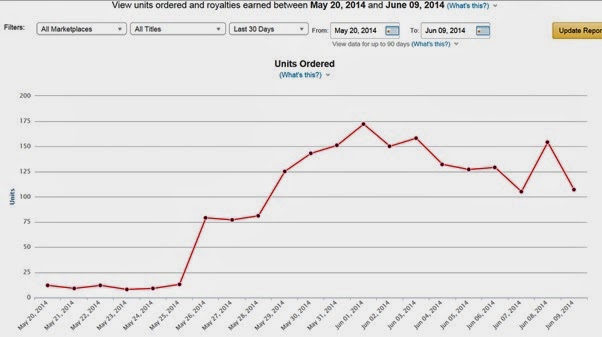
To start off with, here's a long chart of Book 1 and Book 2 of The Touchstone Trilogy, where you can see the impact to my sales over several years.
To give you some idea of how much money is involved in these rankings, first here's my sales for April 2014 (for all books in all Amazon markets) during a period when I had no freebies running.
Since I've released no new books this year, this gives a good idea of what my sales look like with no 'price juicing'. [Non-Amazon sales are currently around a tenth of these amounts.]
And here are my sales for the fortnight or so following the 'Holy Grail' I mentioned earlier - a Bookbub promotion on the back of a free first book in a series.
![]() |
| Amazon Sales - 1 June 2014 to 9 June 2014 |
Sadly, it's rare that price juicing has a permanent impact, but free is definitely a way to get your book out there and it's a hell of a rush to earn the equivalent of a book advance in a fortnight. I gave away around 30,000 free copies of Stray this time (only a tiny fraction of those will ever be read), and will probably simply leave the book on permafree from now on.
And as the years go by, I slowly increase the numbers of 'my' readers out there - people who look specifically for my books and buy them when they're put out. Not because of any price juicing or random encounter in the also-boughts list. The career of a self-publisher can follow a very different path to trade authors (where pre-promotion and first week sales are so important). Mine has been a slow build thing, but fun and interesting and a viable second income.
And most certainly not an endless grind of promotion.
09 June 2014
Murdered: Soul Suspect (no spoilers)
A noir-style mystery set in Salem, where you set out to solve your own murder and stop a serial killer.
Graphics and world
Reasonable, not brilliant, with some suitably spooky touches, especially with the ghosty people that flicker out of existence if you try to get closer to look at them.
Extremely lazy execution, with the same few models used over and over and over again for the people. Salem Police Force is apparently all-male, and for a while there I thought Salem was an all-white environment as well, but a handful of POC showed up about halfway through the game.
Gameplay
Play-style wise, collecting clues and picking the most relevant ones to solve your mystery of the moment is reasonably entertaining, if very forgiving. Walking through (some) walls is amusing, and possessing people and reading their thoughts fun enough the first few times. But it never really built to something compelling, and was remarkable for the number of people who have the exact same thought when you possess them. It's a very half-assed game, taking you through the main story with a few minor sidequests, with very little option for variation. It's also very short. Very very short.
Story
Fedora-wearing ex-con cop is murdered by masked serial killer, runs around as a ghost trying to solve own murder. His wife redeems him and is fridged in the first flashback. Most of the people he helps as a ghost are young girls and women apparently incapable of keeping it together as well as ex-con cop ghosts.
I won't spoil the story, other than to note that I give the identity of the killer extreme side-eye given the historical rather than fictional story, and rather wonder why all mediums are women (almost all of them young).
Anyways, it's light entertainment, not very well executed, tolerable if you feel the need for more drawling tough-guy in your gaming life, and absolutely not worth the premium game price it's being sold at.
Graphics and world
Reasonable, not brilliant, with some suitably spooky touches, especially with the ghosty people that flicker out of existence if you try to get closer to look at them.
Extremely lazy execution, with the same few models used over and over and over again for the people. Salem Police Force is apparently all-male, and for a while there I thought Salem was an all-white environment as well, but a handful of POC showed up about halfway through the game.
Gameplay
Play-style wise, collecting clues and picking the most relevant ones to solve your mystery of the moment is reasonably entertaining, if very forgiving. Walking through (some) walls is amusing, and possessing people and reading their thoughts fun enough the first few times. But it never really built to something compelling, and was remarkable for the number of people who have the exact same thought when you possess them. It's a very half-assed game, taking you through the main story with a few minor sidequests, with very little option for variation. It's also very short. Very very short.
Story
Fedora-wearing ex-con cop is murdered by masked serial killer, runs around as a ghost trying to solve own murder. His wife redeems him and is fridged in the first flashback. Most of the people he helps as a ghost are young girls and women apparently incapable of keeping it together as well as ex-con cop ghosts.
I won't spoil the story, other than to note that I give the identity of the killer extreme side-eye given the historical rather than fictional story, and rather wonder why all mediums are women (almost all of them young).
Anyways, it's light entertainment, not very well executed, tolerable if you feel the need for more drawling tough-guy in your gaming life, and absolutely not worth the premium game price it's being sold at.
06 June 2014
Pyramids and alt-worldbuilding and language
Still making my way slowly through the first draft of Pyramids. The characters have settled and become more real to me and - as usual with my first drafts - I'm alternating between taking days over a handful of paragraphs, and then trotting merrily through the next couple of pages, and then hitting a go-slow again. I'm not someone who can "just put words on the page" and then go back and fix it. If the foundation of the preceding events doesn't ring true for me, then I won't be able to build on it.
So far, it's quite a 'busy' novel in that there's a lot of different threads all running through each other - my poor characters just want to investigate a murder, and all this other stuff keeps happening to them, and some of it is relevant and some of it isn't but is kind of overwhelmingly important to the rest of their lives (and the rest of the series).
Without a doubt the most worldbuilding heavy story I'm ever going to write - perhaps inevitable given the starting point of our world. Also by far the highest in terms of magical creatures - both Touchstone and Stained Glass Monsters technically had scads of different creatures, but you really only 'met' a couple. I'm coming up on writing the primary triskelion scene and I'm really looking forward to it - without doubt one of my most favourite (and odd!) creatures. Although I'm very fond of the folies and the amasen as well.
Amasen is a neologism for a creature depicted in Celtic art that has no known name (as opposed to triskelion, which is a co-opted word, and folies, which is simply a development of 'foliate') and neologisms are one of the big balancing acts that writing such a very alt world requires.
Technically all the characters are speaking Prytennian, which is what I'm pretending you'd get if you took the language of southern Britain around the time of the Roman withdrawal, and kept it as a distinct and defended language group (ending up with not-quite-Welsh) but then incorporated a bunch of Egyptian while expanding northward through existing Latin territories, and then territories strongly influenced by Norse, and also the various multiple waves of invasion that Britain went through - so you do still get your Anglo and your Saxon and your French in there, but all the balances are different. And all the while all the other languages are developing and evolving on their own account. Norse becomes a Swedish which is not quite current Swedish. Latin is a living language that has grown and changed.
And then I, fool author, write it all out in English anyway, and have to make a million little decisions like: what is the money called? Do I keep pound and sovereign and shilling because that's less work for the reader, even though it makes no sense etymologically? What about all the place names? Londonium has become London, but the Tamesis did not shift to Thames. Anything with 'kirk' and other Christian-rooted names don't exist because Rome had strong reasons to stick with Jupiter, and that of course makes enormous differences.
My current choice is the standard form of polite address. Mr and Miss and Mrs and all that - would Prytennian still use that? French doesn't have nearly the same ties, and Prytennians would not use an honorific to distinguish between married and unmarried women (because their rulers, the Suleviae, don't marry and so marriage has become less of a focal point of female identity). I've gone through many options to find a word I like! I ended up wishing we used the Japanese honorific system, which doesn't even distinguish between polite address for men or women (-san) or tag gender to most titles. Currently I'm caught between using "dama" for women and "daman" for men - or to just use "damin" for both men and women. Both options have advantages.
Anyway - I am always slow at first drafts, but now I have added excuses! Plus at the beginning of August I leave for three months in the UK, and it's hard to guess how that will impact my output since I do most of my writing on the train to work each morning. I am speeding up a little, because I know my characters and world quite well at this point, but I can still make no real estimates about release dates.
I am, however, really looking forward to sharing this world and these people with you all.
So far, it's quite a 'busy' novel in that there's a lot of different threads all running through each other - my poor characters just want to investigate a murder, and all this other stuff keeps happening to them, and some of it is relevant and some of it isn't but is kind of overwhelmingly important to the rest of their lives (and the rest of the series).
Without a doubt the most worldbuilding heavy story I'm ever going to write - perhaps inevitable given the starting point of our world. Also by far the highest in terms of magical creatures - both Touchstone and Stained Glass Monsters technically had scads of different creatures, but you really only 'met' a couple. I'm coming up on writing the primary triskelion scene and I'm really looking forward to it - without doubt one of my most favourite (and odd!) creatures. Although I'm very fond of the folies and the amasen as well.
Amasen is a neologism for a creature depicted in Celtic art that has no known name (as opposed to triskelion, which is a co-opted word, and folies, which is simply a development of 'foliate') and neologisms are one of the big balancing acts that writing such a very alt world requires.
Technically all the characters are speaking Prytennian, which is what I'm pretending you'd get if you took the language of southern Britain around the time of the Roman withdrawal, and kept it as a distinct and defended language group (ending up with not-quite-Welsh) but then incorporated a bunch of Egyptian while expanding northward through existing Latin territories, and then territories strongly influenced by Norse, and also the various multiple waves of invasion that Britain went through - so you do still get your Anglo and your Saxon and your French in there, but all the balances are different. And all the while all the other languages are developing and evolving on their own account. Norse becomes a Swedish which is not quite current Swedish. Latin is a living language that has grown and changed.
And then I, fool author, write it all out in English anyway, and have to make a million little decisions like: what is the money called? Do I keep pound and sovereign and shilling because that's less work for the reader, even though it makes no sense etymologically? What about all the place names? Londonium has become London, but the Tamesis did not shift to Thames. Anything with 'kirk' and other Christian-rooted names don't exist because Rome had strong reasons to stick with Jupiter, and that of course makes enormous differences.
My current choice is the standard form of polite address. Mr and Miss and Mrs and all that - would Prytennian still use that? French doesn't have nearly the same ties, and Prytennians would not use an honorific to distinguish between married and unmarried women (because their rulers, the Suleviae, don't marry and so marriage has become less of a focal point of female identity). I've gone through many options to find a word I like! I ended up wishing we used the Japanese honorific system, which doesn't even distinguish between polite address for men or women (-san) or tag gender to most titles. Currently I'm caught between using "dama" for women and "daman" for men - or to just use "damin" for both men and women. Both options have advantages.
Anyway - I am always slow at first drafts, but now I have added excuses! Plus at the beginning of August I leave for three months in the UK, and it's hard to guess how that will impact my output since I do most of my writing on the train to work each morning. I am speeding up a little, because I know my characters and world quite well at this point, but I can still make no real estimates about release dates.
I am, however, really looking forward to sharing this world and these people with you all.
18 May 2014
Godzilla (2014) - no spoilers
A friend of mine (hi Jennies!) used to be full of stories about disasters that would happen to people around her. She would always be unscathed, and yet incidents would happen in her vicinity. The lead character in the 2014 version of Godzilla, an American bomb disposal guy called Brodie, appears to be the kind of person who should clearly announce his intention to visit any city, so that the citizens can start to evacuate in time.
The set-up of Brodie's back story is the weakest part of this movie - it simply takes too long and is completely pointless, adding almost nothing to the pay off.
However, once we start with the giant monsters, this is definitely a stand-out movie. I'd place it well above Pacific Rim in the awe and majesty department, with some truly beautiful visuals and a real tangible sense of humans as tiny specks. It is both gripping and in some moments nerve-wracking.
Of course, that's not to say that the story isn't full of ludicrous developments of the "why would any sane (or insane) organisation think that was a good idea" level. A great many things happen in this story purely to set up a cool scene. The number of people who just stand around when there's a giant monster attacking is astonishing. [Particularly hilarious are the people in a skyscraper who were apparently so engrossed in a business meeting that they failed to notice a city-wide evacuation and a skyscraper collapsing. Also, people remain remarkably clean around skyscraper collapses - clouds of dust happen and they walk out of it all shiny-faced.]
Sadly, the movie falls down in both gender and racial aspects. For a story that spends a good portion of time in Japan, there seems to be a lot of American guys in charge, and only one Japanese main character, who spends his time primarily being shell-shocked, with occasional scientific observation. Just as bad are the female roles, that are the usual "die for men to grieve over", "be in danger for men to try and reach" and "be an assistant".
Still, this is a definite one to watch for the enormous monsters fighting.
The set-up of Brodie's back story is the weakest part of this movie - it simply takes too long and is completely pointless, adding almost nothing to the pay off.
However, once we start with the giant monsters, this is definitely a stand-out movie. I'd place it well above Pacific Rim in the awe and majesty department, with some truly beautiful visuals and a real tangible sense of humans as tiny specks. It is both gripping and in some moments nerve-wracking.
Of course, that's not to say that the story isn't full of ludicrous developments of the "why would any sane (or insane) organisation think that was a good idea" level. A great many things happen in this story purely to set up a cool scene. The number of people who just stand around when there's a giant monster attacking is astonishing. [Particularly hilarious are the people in a skyscraper who were apparently so engrossed in a business meeting that they failed to notice a city-wide evacuation and a skyscraper collapsing. Also, people remain remarkably clean around skyscraper collapses - clouds of dust happen and they walk out of it all shiny-faced.]
Sadly, the movie falls down in both gender and racial aspects. For a story that spends a good portion of time in Japan, there seems to be a lot of American guys in charge, and only one Japanese main character, who spends his time primarily being shell-shocked, with occasional scientific observation. Just as bad are the female roles, that are the usual "die for men to grieve over", "be in danger for men to try and reach" and "be an assistant".
Still, this is a definite one to watch for the enormous monsters fighting.
Subscribe to:
Posts (Atom)
Excuses, excuses
My Steam history might explain why there's no new book this year, but it's more just reading. I've been exceptionally inclined...
-
Life is Strange is a recently-concluded Square Enix game set in a US high school where our girl photographer protagonist Max discovers her...
-
[Contains spoilers for The Book of Firsts .] The first two reverse (female protagonist) harems I really recall encountering are Ouran High S...
-
Cute Demon Crashers is unique in my experience. Admittedly, I'm not an expert in the otome gaming area, but most (non-puzzle/time mana...